
Industrial Equipment Industry, Strategy & business Development
Aftermarket Services: Why OEMs Are Under-Capturing Installed Base Value
The Most Valuable Sale Happens After Delivery
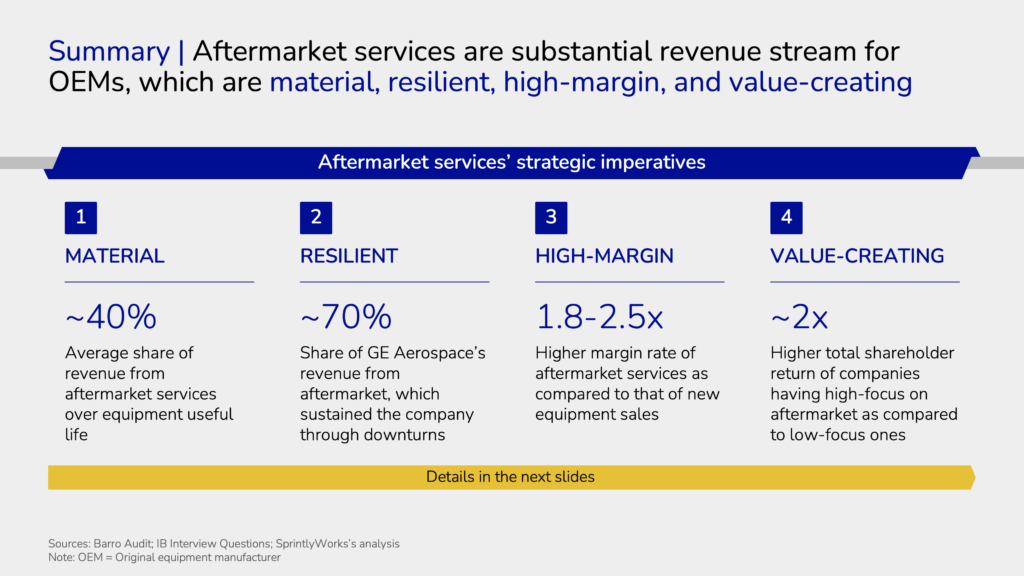
For industrial OEMs, the equipment sale is increasingly just the beginning of the value story. Aftermarket services can generate around 40 percent of revenue over an equipment’s useful life, with margins approximately 1.8 to 2.5 times higher than new equipment sales. Unlike deferrable capital expenditure, demand for parts, maintenance, and services continues throughout the economic cycle.
The capital markets recognise this difference. Companies with a stronger aftermarket focus can deliver higher valuation multiples and roughly twice the total shareholder return of less focused peers. Aftermarket is therefore not simply a service function. It is a source of recurring revenue, margin resilience, and enterprise value.
Owning the Installed Base Does Not Mean Owning the Revenue
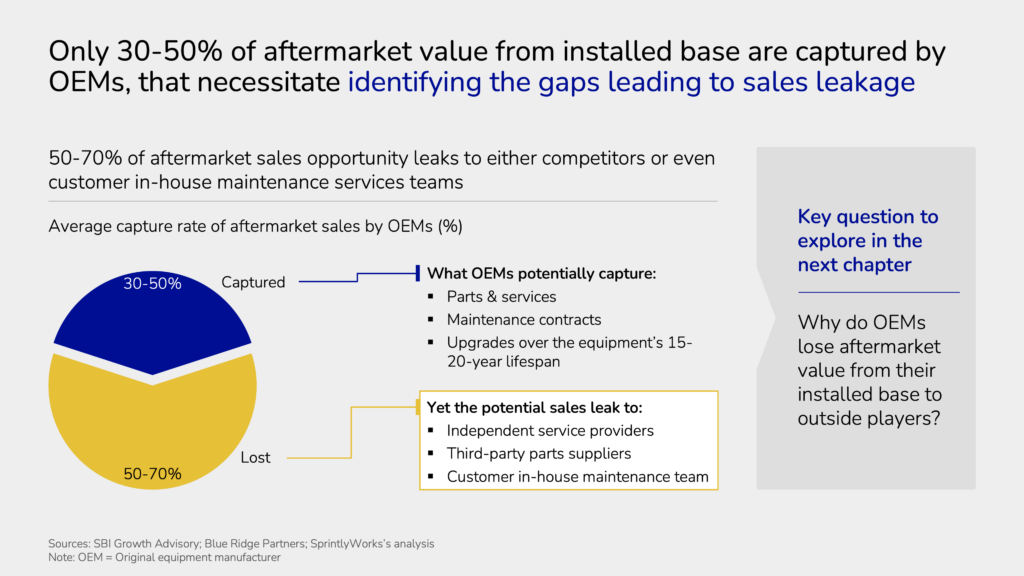
OEMs design the equipment, sell it, and often possess the deepest technical knowledge of how it operates. Yet they capture only 30 to 50 percent of the aftermarket potential generated by their own installed base. The rest leaks to independent service providers, third-party parts suppliers, and customers’ internal maintenance teams.
This leakage comes from four recurring gaps. OEMs may lack the speed and geographical reach customers need. They may use pricing models that overprice common parts while underpricing specialised ones. They may have limited visibility into what equipment is operating, where it is located, and what condition it is in. They may also manage aftermarket as a support activity rather than a dedicated commercial business.
The uncomfortable truth is that technical ownership does not guarantee commercial ownership. Once the warranty ends, customers reassess who can serve them fastest, most conveniently, and at the clearest value.
Independent Providers Are Winning Where OEMs Move Too Slowly
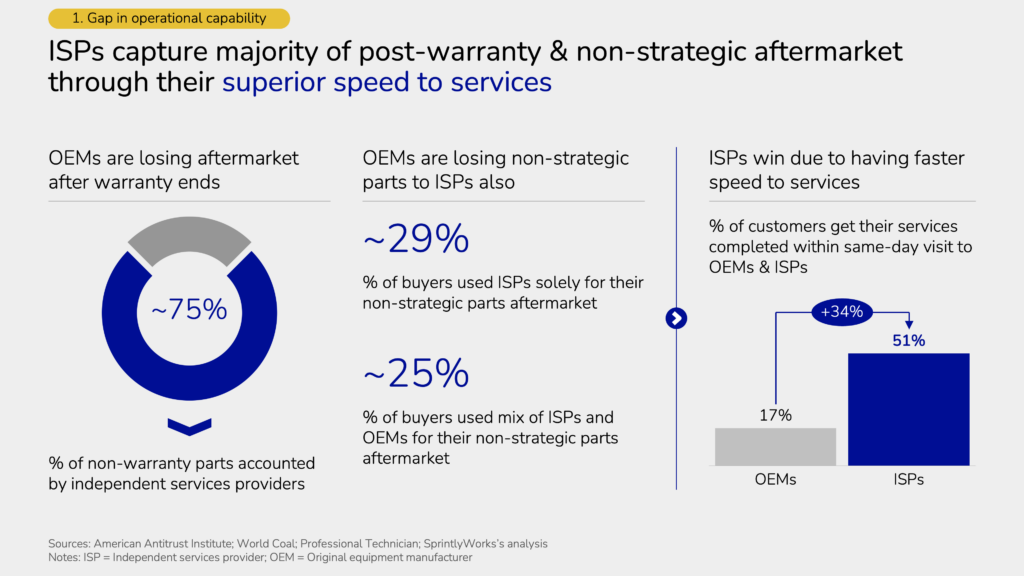
Independent service providers are not necessarily winning because they understand the equipment better. They are winning because they often make the customer’s life easier. In the study, around 51 percent of ISP service visits were completed on the same day, compared with only 17 percent for OEMs.
Their multi-brand model also creates a structural advantage. A customer with equipment from several manufacturers can work with one service partner instead of managing separate contracts, technicians, and parts channels for each brand. This is particularly powerful in rural or dispersed locations, where proximity and availability can matter more than brand loyalty.
OEMs still hold important strengths. Genuine parts can offer greater reliability, and design ownership creates a moat around complex and proprietary systems. But a premium becomes difficult to defend when customers cannot see the operational benefit. Reliability without speed, availability, or convenience is rarely enough to secure the full aftermarket relationship.
Winning Back Aftermarket Requires Operating Model Choices
Closing the gap requires more than improving individual service processes. OEMs must decide where to compete directly, where to partner, and where to redesign their operating model.
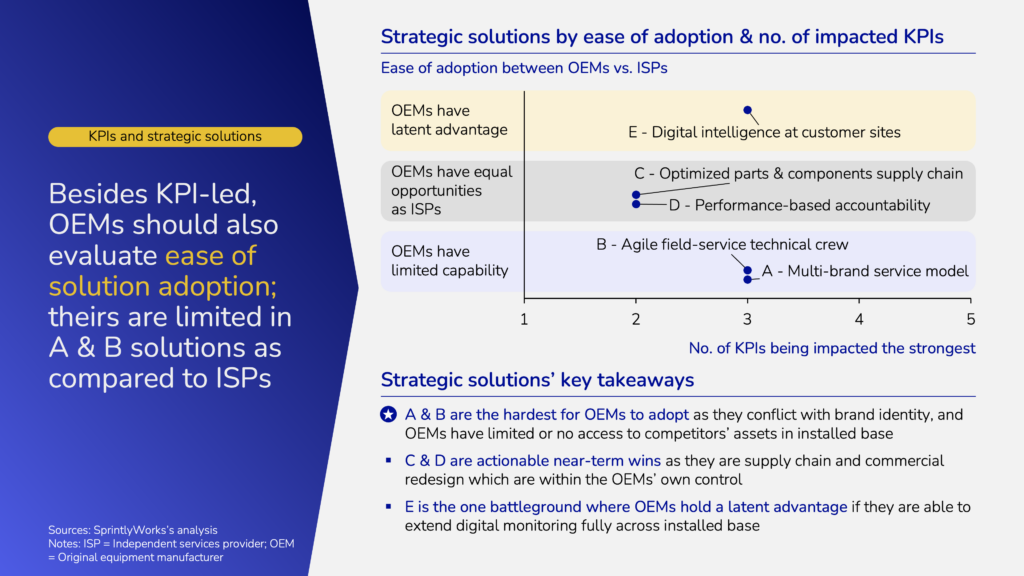
Some moves are within immediate control. OEMs can optimise parts supply chains around customer demand rather than dealer territories. They can introduce performance-based offerings built around uptime, availability, or cost per operating hour. They can also use digital monitoring to predict failures, trigger proactive service, and create a clearer view of the installed base.
Other moves are structurally harder. Building a multi-brand service model may conflict with an OEM’s identity and require access to competitors’ equipment. Creating a broad field-service footprint can also demand significant investment. In these areas, partnerships with independent providers may offer a faster route to geographical coverage and customer convenience without diluting the core brand.
The winning model will not be the same for every OEM. But the principle is consistent: aftermarket strategy must be designed around the customer’s operating reality, not the manufacturer’s existing organisational boundaries.
The Installed Base Will Not Stay Loyal by Default
The aftermarket opportunity is attractive precisely because equipment remains in operation for 15 to 20 years. But that long lifetime also gives competitors repeated opportunities to enter the customer relationship.
If OEMs reclaim the aftermarket value of their installed base, it will be because they stop assuming that product ownership creates customer loyalty and start proving their value through speed, visibility, pricing intelligence, and measurable uptime.
The board-level question to end on:
When customers choose who will maintain your equipment for the next decade, will they see you as “the company that originally built the machine” or as “the partner best equipped to protect its lifetime performance”?
To view the full case study with detailed approach and results, click to download!
Download full report here:
More Case Studies
Have a similar requirement?
Contact us today to learn more about on-demand workforce and accelerate development on your most pivotal projects!
Finding where that value is actually leaking, and what it would take to capture it, is what an aftermarket and service sprint does.
Quick Reads for Big Impact
Featured Case Studies


Quick Reads for Big Impact
Accelerating Success for Enterprises in 20+ Geographies

Launch Your Sprint with
Define your project, connect with top-tier consultants, and start making progress fast.
Download the full report
Enter your email to access this exclusive case study.